
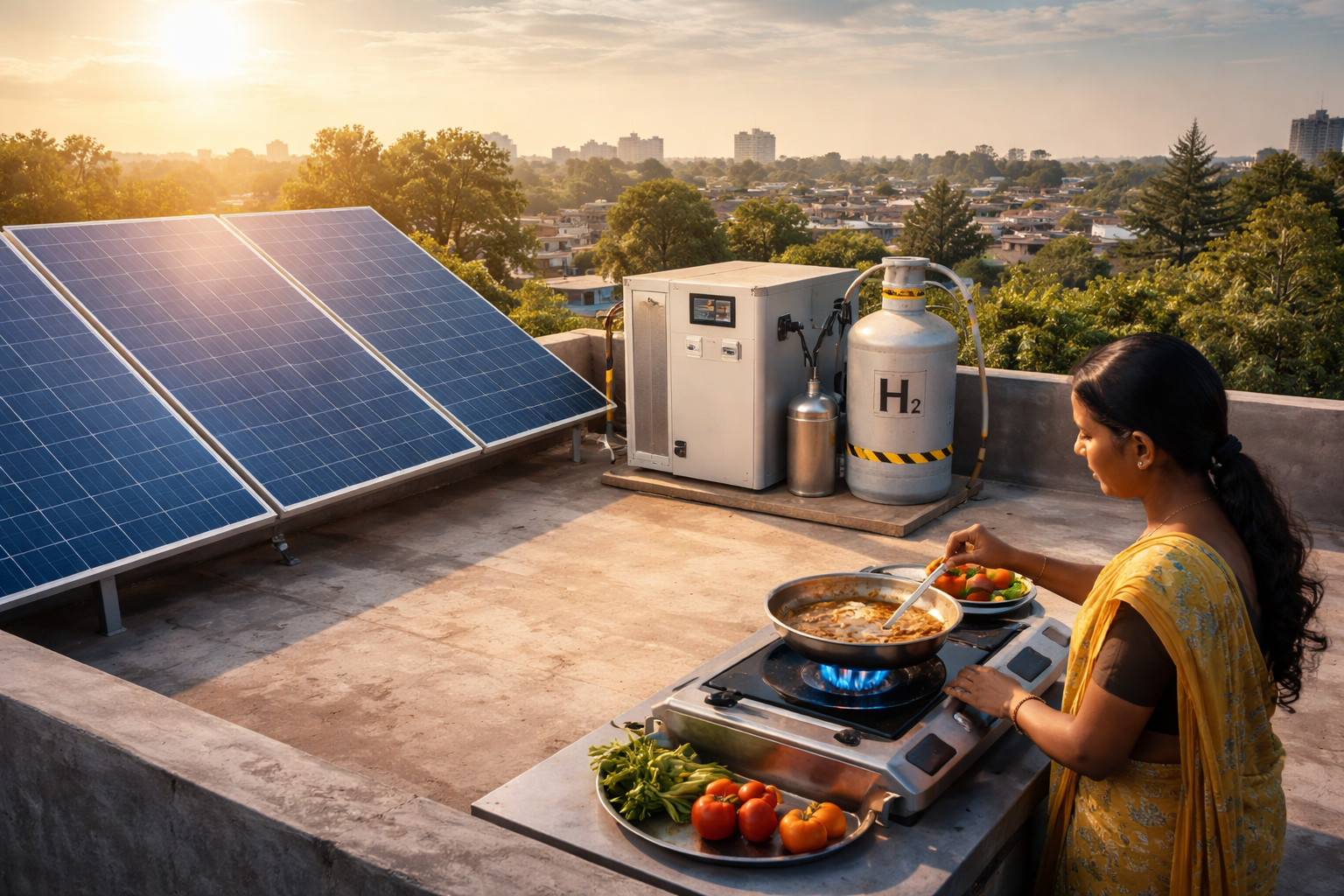
National Pilot Framework: Decentralised Solar–Hydrogen Clean Cooking Infrastructure
Can Solar Hydrogen Cooking Systems Transform Household Energy in India?
India’s energy transition has made strong progress in renewable power generation. Solar capacity is growing rapidly. Green hydrogen policy is evolving. Industrial decarbonisation is also gaining momentum.
However, one major question remains unanswered:
Can clean energy move beyond grid-scale power and transform household cooking infrastructure?
Cooking energy is not optional. It is a daily necessity for more than 300 million households in India.
Despite renewable energy growth, domestic cooking still depends heavily on imported LPG. As a result, this creates:
- Rising fiscal pressure
- Energy security risks
- Exposure to indoor air pollution
- Supply chain vulnerabilities
To address this gap, Garv Industries Pvt. Ltd., a DPIIT-recognised startup (Certificate No. DIPP194460), is developing a structured national pilot.
The goal is simple:
To evaluate whether decentralised solar hydrogen cooking systems in India can become a long-term clean cooking solution.
This is not a technology showcase.
Instead, it is a controlled infrastructure validation project.
The Household Energy Gap in India’s Clean Transition
India’s hydrogen mission, led by the Ministry of New and Renewable Energy, mainly focuses on:
- Industrial decarbonisation
- Mobility solutions
- Export opportunities
However, household cooking remains largely excluded from hydrogen adoption plans.
This creates several long-term challenges.
Continued LPG Import Dependence
India still relies heavily on LPG imports for household cooking needs. This increases vulnerability to global price fluctuations.
Subsidy Pressure
Government subsidies continue to face increasing financial pressure.
Indoor Air Pollution
Women are often the most affected by poor indoor air quality caused by traditional cooking systems.
Rural Distribution Challenges
Many rural areas still face fuel delivery and supply issues.
Limitations of Solar Cooking
Traditional solar cooking systems often fail because they lack reliable energy storage.
Therefore, India needs evidence-based clean cooking pilots, not premature nationwide rollouts.
How the Solar Hydrogen Pilot Will Work
Garv Industries Pvt. Ltd. plans to deploy 100 decentralised solar hydrogen cooking systems over an 18 to 24-month pilot period.
Each household system will include:
- 1–1.5 kW rooftop solar PV
- ~250W electrolyser
- Low-pressure hydrogen storage
- Hydrogen-compatible cooking stove
- Multi-layer safety systems
- Battery backup
Safety systems include:
- Pressure relief valves (PRVs)
- Flame arrestors
- Leak detection systems
The target Technology Readiness Level (TRL) is 6–7, which means the solution is ready for pilot testing.
What This Pilot Will Measure
The project will collect real-world data in five important areas.
1. Technical Reliability
Can the system perform consistently in daily household use?
2. Safety Compliance
Can it align with BIS and PESO regulations?
Bureau of Indian Standards
Petroleum and Explosives Safety Organisation
3. LPG Replacement
How much LPG usage can these systems reduce?
4. Carbon Reduction
The pilot will measure household CO₂ savings.
5. User Adoption
The project will gather direct feedback from households, especially women-led homes.
The expected system lifecycle is 25 years, depending on validation results.
Financial Planning for Solar Hydrogen Cooking Systems in India
Infrastructure projects need financial discipline.
The estimated pilot cost is around ₹2.4 lakh per household.
During large-scale manufacturing, the company aims to reduce costs to ₹1.8–2 lakh per household.
Funding will support:
- Hardware deployment
- Safety certification
- IoT monitoring systems
- Electrolyser durability testing
- Independent audits
- Governance reporting
This phased investment model reduces risk before expansion.
Regulatory Roadmap
Scaling clean cooking infrastructure requires regulatory approval.
The roadmap includes three phases:
Phase 1: Technical Validation
Field testing and safety assessment
Phase 2: Certification
Alignment with national standards
Phase 3: Policy Submission
Reporting findings to public authorities
The company is prioritising validation before scaling.
Leadership Behind the Initiative
Large infrastructure projects need experienced leadership.
The project includes:
Sudhanshu Saini – Founder & CEO
Dr. S. P. Sharma – CTO & Technical Advisor
Former General Manager at NTPC Limited
IIT Indian Institute of Technology Roorkee alumnus
Vijendra Kumar Nagyan – Infrastructure Advisor
Former Senior Vice President at Larsen & Toubro
Prof. R. K. Kotnala – Scientific Lead
Chairman of New Science Creators Institute
Dr. Jyoti Shah – Research & Validation
New Science Creators Institute
Additionally, the company operates with a women-majority board structure.
This strengthens governance diversity while supporting the social goals of clean cooking transformation.
Potential Public Benefits
If successful, solar hydrogen cooking systems in India could deliver major public benefits.
Energy Security
Lower LPG import dependence
Public Health
Cleaner indoor air
Women’s Empowerment
Improved access to locally generated fuel
Environmental Benefits
An estimated 1.6–2 tonnes of CO₂ reduction per household annually
Policy Development
Real-world data for future clean cooking policies
Why Pilot Projects Matter
Large infrastructure transitions do not begin with immediate scale.
They begin with pilot projects that answer critical questions.
This national pilot aims to determine whether solar hydrogen cooking systems in India can become a reliable household energy solution through:
- Structured validation
- Regulatory compliance
- Transparent monitoring
- Strong governance
India’s clean energy future cannot focus only on large-scale power generation.
It must also solve household energy challenges—and clean cooking is one of the biggest opportunities.
Very good i like it