
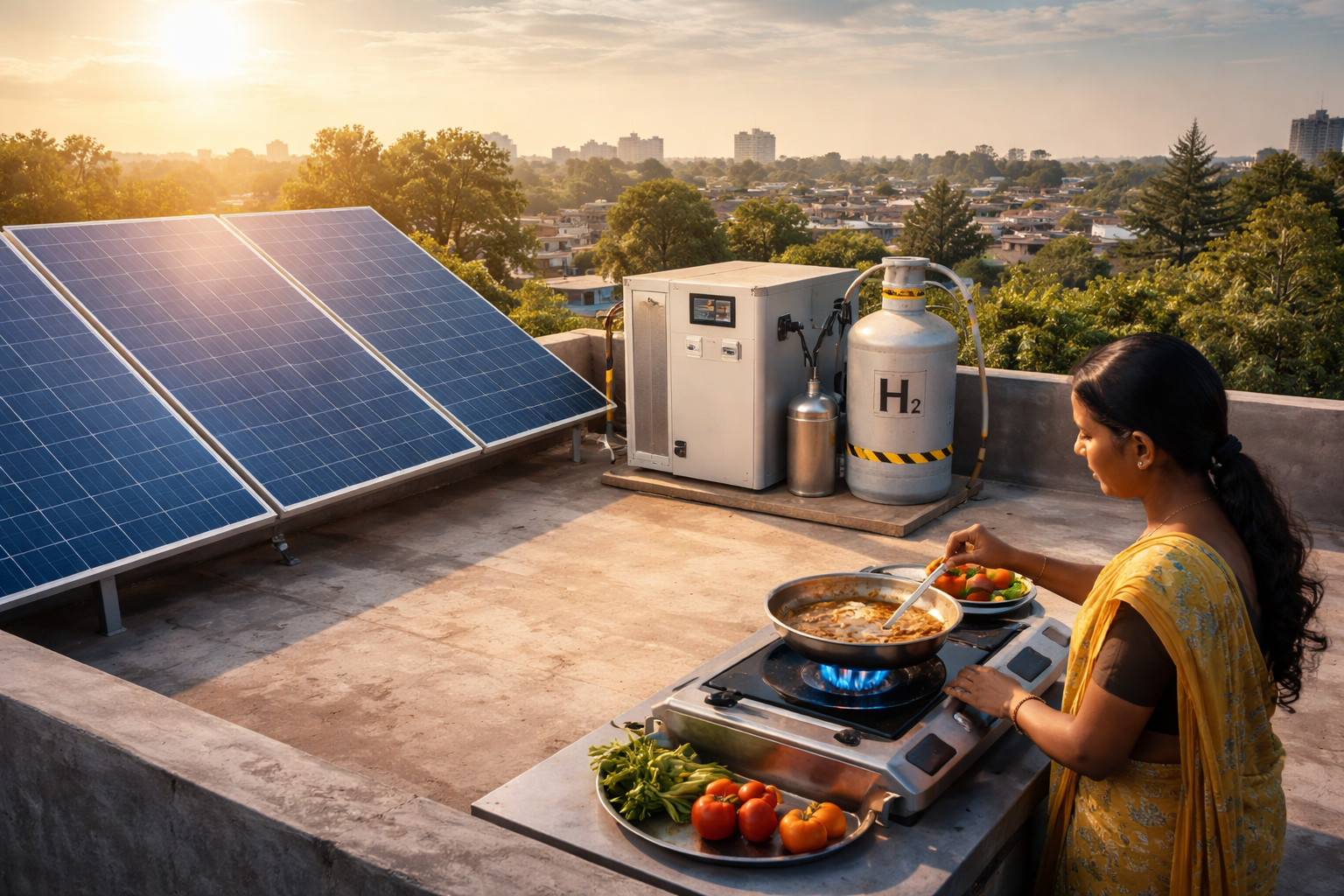
National Pilot Framework: Decentralised Solar–Hydrogen Clean Cooking Infrastructure
India’s energy transition has made measurable progress in renewable power generation. Solar capacity has expanded rapidly, green hydrogen policy has been articulated and industrial decarbonisation is gathering momentum.
Yet one structural question remains largely unaddressed:
Can clean energy move beyond grid-scale power and enter household-level infrastructure especially domestic cooking?
Cooking energy is not discretionary. It is a daily necessity for over 300 million households across India. Despite policy evolution and renewable expansion, domestic cooking continues to depend heavily on imported LPG. This creates fiscal pressure, energy security vulnerability and continued exposure to indoor air pollution risks.
In response to this structural gap, Garv Industries Pvt. Ltd., a DPIIT-recognised startup (Certificate No. DIPP194460), is developing a structured national pilot to examine whether decentralised solar–hydrogen systems can serve as a viable long-term clean cooking infrastructure model.
This initiative is not positioned as a technology showcase.
It is designed as a controlled infrastructure validation exercise.
The Structural Gap in Household Energy Transition
India’s hydrogen ambitions, guided by the Ministry of New and Renewable Energy, have primarily focused on industrial usage, mobility and export pathways.
However, household energy -despite its scale and public health implications-remains largely outside hydrogen integration frameworks.
Key realities persist:
- Continued LPG import dependence
- Ongoing subsidy rationalisation pressures
- Indoor air pollution disproportionately affecting women
- Rural distribution inefficiencies
- Solar cooking solutions lacking energy storage capability
These challenges signal the need for evidence-based infrastructure pilots, rather than speculative nationwide rollouts.
Designing a Controlled National Pilot
Garv Industries proposes a structured deployment of 100 decentralised solar–hydrogen household systems over an 18–24 month evaluation period.
Each system integrates:
- 1–1.5 kW rooftop solar PV
- ~250W electrolyser
- Low-pressure hydrogen storage
- Hydrogen-compatible cooking stove
- Multi-layer safety systems (PRVs, flame arrestors, leak detection)
- Battery backup
Target Technology Readiness Level: 6–7 (pilot-ready stage)
The pilot aims to generate structured data across five dimensions:
- Technical reliability under real household usage
- Safety validation pathways aligned with BIS & PESO
- LPG displacement metrics
- CO₂ reduction measurement
- User adoption insights, with focused feedback from women-led households
The proposed system lifecycle is 25 years, subject to validation outcomes.
Structured Financial Discipline
Infrastructure pilots demand financial clarity and governance discipline.
The estimated pilot cost is approximately ₹3 lakh per household, with a future optimisation target of ₹1.8–2.0 lakh during scaled manufacturing phases.
Capital allocation is structured across:
- Hardware deployment (100 systems)
- Safety validation & certification pathways
- IoT-based performance monitoring
- Electrolyser durability optimisation
- Independent technical and financial audits
- Governance and compliance reporting
This phased structure prioritises regulatory alignment and reliability before expansion.
Regulatory & Compliance Roadmap
Scaling decisions in energy infrastructure must be evidence-driven.
The roadmap is divided into three structured phases:
Phase 1 – Technical Validation
Field performance and safety assessment
Phase 2 – Certification Engagement
Alignment with BIS and PESO standards
Phase 3 – Policy Data Submission
Structured reporting to relevant public authorities
The objective is not immediate expansion – but validated, data-backed evaluation.
Governance & Leadership Structure
Large-scale infrastructure transformation requires engineering discipline, regulatory literacy, and scientific oversight.
The leadership structure reflects that requirement:
- Sudhanshu Saini – Founder & CEO
- Dr. S. P. Sharma – CTO & Technical Advisor
Former General Manager, NTPC Limited; IIT Roorkee alumnus - Vijendra Kumar Nagyan – Advisor, Infrastructure Implementation
Former Senior Vice President, Larsen & Toubro (Hydro Power Projects) - Prof. R. K. Kotnala – Scientific Lead
Chairman, New Science Creators Institute - Dr. Jyoti Shah – Research & Validation
New Science Creators Institute
The company operates with a women-majority board structure, reinforcing governance diversity and aligning leadership with the social dimensions of clean cooking transition.
Public Interest Outcomes Under Evaluation
If validated, decentralised solar–hydrogen cooking systems may contribute to:
Energy Security
Reduced LPG import dependence
Public Health
Cleaner indoor air environments
Women’s Safety & Agency
Decentralised, locally generated fuel access
Environmental Impact
Estimated 1.6–2 tonnes CO₂ avoided per household annually (subject to validation)
Policy Evidence
Creation of structured data for future clean cooking programme design
A Disciplined Approach to Infrastructure Transition
Large infrastructure transitions rarely begin with immediate scale.
They begin with controlled pilots that answer regulatory, technical and economic questions before expansion.
The National Pilot for Decentralised Solar–Hydrogen Cooking Systems represents an effort to explore whether hydrogen can responsibly enter the household energy domain through:
- Structured validation
- Compliance alignment
- Transparent monitoring
- Governance-led execution
Very good i like it